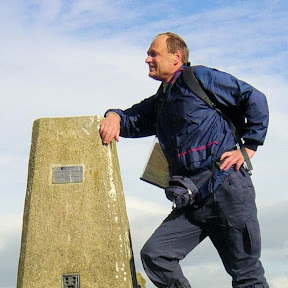
Malana, Himachal Pradesh, India
Deep in Northern India, on the fringes of the Himalayas lies a valley which for much of the year is impassable due to snow. It is a million miles away from civilisation and offers up arguably the most beautiful and lush part of the whole subcontinent. Keen trekkers will no doubt have heard about the Valley of Flowers and the Pin Parvati Valley.
Author: Stuart Wilson
Statistics and Details
End: Malana Holding Pond
Time: Minimum half-day up to 2 days
Rating: Strenuous / Remote
The Walk
It has dealt up centuries of dreams passed on from those lucky and intrepid explorers who dared to take that extra step into the unknown.
Kasol is the penultimate stop along the Parvati Valley and just a few km from Manikaran, which is the last stop. From there you continue to head east up to the second highest road pass in the world (Pin Parvati Pass) and then on toward Tibet. This should give you some idea of just how isolated this area is.
The Parvati Valley, for all its beauty, is home to the best, most potent, most awarded, and most revered marijuana in the world. Like everywhere else in Himachal Pradesh it grows wild, and plants up to about 9ft are common. In the Parvati however it is cultivated and sold, and it has made millionaires of farmers who once lived on the breadline. However, with drugs comes cartels and with cartels comes trouble.
Since the mid-nineties dozens of tourists have gone missing in the valley; many have turned up dead, many haven't turned up at all. Stories of tourists heading to the valley, then getting murdered are all too common. Bodies get washed up on river banks and in various decomposing states have also been found in the mountains. No one speaks about it, and the police struggle to solve any of these cases, often finding it difficult to even pick up any leads. Travel within the valley alone (without a guide) is dangerous and has been proven to be deadly all too regularly. Locals are reluctant to speak, and a few years ago the Guardian (UK) sent reporters to find out why people were going missing without any real sense of investigation. Locals shut them out, they were spat at, and even foreigners seemed annoyed and hostile of their presence. What they uncovered was something of conspiracy theories, something they could never envisage and something that when first warned by the local paper they dismissed as ridiculous.
They were told by a local paper that actually, those foreigners who had been found dead may have crossed the wrong people. The drugs trade is rife in the mountains, and a survivor who saw his 14-year-old son and female companion slaughtered was testament to the fact that there were robberies in the valley.
Oddly enough, in communities so intertwined, no one saw or heard anything. However, there was no doubt that foreigners had stumbled across people who would expire them sooner than they had hoped. It was also likely that foreigners unaccustomed to the ferocious landscape had succumbed to nature and died as a result of poor planning, or by way of misadventure. The Indian police accept there is a problem, and Himachal Pradesh tourism has suffered greatly as a result of the murders and disappearances. The Guardian report makes for fascinating reading here.
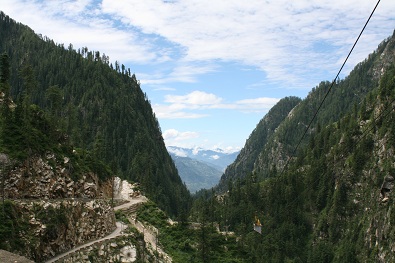 The Parvati Valley
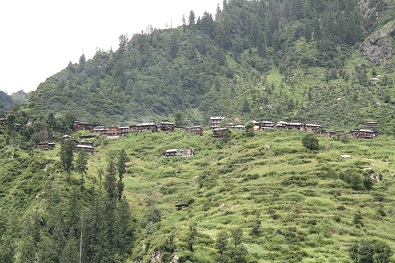 Malana
Even now there is no clear evidence of the murders, disappearances, or supposed foreigner enclaves. One thing is certain though, and endorsed by governments all over the world — including the Indian Government and by every major guidebook — trekking in the valley without a guide is dangerous. A guide can steer you away from not just hefty cliffs and imminent death, but will have knowledge of potential hotspots of trouble. Yes, the valley is amazing, and yes it leaves you itching to experience its magnitude and beauty, but it's not worth dying for! With that in mind, and with young kids in tow, we were in the valley for one particular trek — a hike that would take us to one of the highest villages and to one of the last civilisations on earth.
A few thousand years ago Alexander the Great was making his way over the Himalayas looking for someone to defeat. The harsh terrain was too much for him and his army to bear, and so they decided to stop and create a village where they could found families and live in peace. He eventually left, but the remnants of his army remained. The village, known as Malana, sits some 3,200m high in the mountains of the Parvati Valley. For years no one knew of the village, and over the course of time the village became self-sufficient, self-governing, and completely withdrawn. No one was allowed in unless invited and no one left due to the fact anywhere was at least a day's arduous and dangerous trek away — and in many cases much is the same today. The village of Malana sits in the same spot, perched high on the plateau of a mountain and flanked by the peaks of Chandrakhani (3,650m) and Deotibba (6,000m), hidden at least an hour's drive through a difficult and dangerous mountain road and completely on the way to nowhere. It is said by many to be the last isolated civilisation in the world and is renowned for being the most ancient civilisation anywhere on earth. The village still remains completely unreachable by road, and any visitor enters at the behest of the villagers and following a lengthy, back-breaking trek all uphill and against the symptoms of altitude sickness. The Indian authorities leave Malana well alone, and so the small village of cinder houses and their occupants remain free to self-govern and as a result create their own laws. The villagers are devout Hindus, but have created their own unique caste system (class system), but beyond that they deem themselves to be the pinnacle of human beings, followed by normal Hindus and then the low caste — i.e., worst of the worst are non-believers. Particular hatred is aimed at westerners, particularly white westerners, and so they are extremely unwelcome in the village.
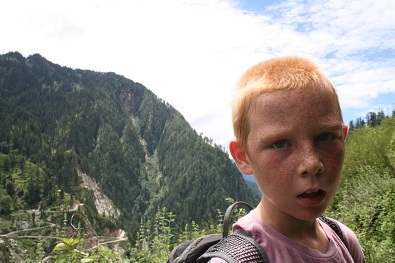 The trek was hard
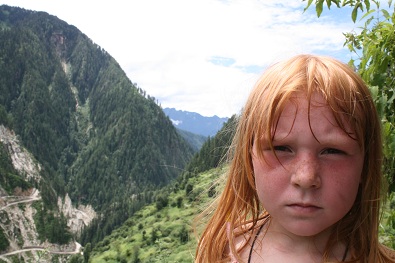 Altitude began to kick in
We drove for around half an hour west along the valley; the road is in poor condition, and so travelling even a kilometre takes a good deal of time. There are now several ways of getting to Malana village. Up until a couple of years back there was just two. The first is trekking direct from Jari — it's around 17km and takes at least a day, and travellers would then camp somewhere and walk back the following day. A killer of a hike deemed to be very hard and not for the faint-hearted, and certainly not for those with children, but I imagine immensely rewarding. The second option is to take the road down past the hydro plant where you should register (you need your passport) and then continue on for about an hour until you reach a further hydro plant and what seems like the last place on earth. Continue onward up the road which becomes extremely dangerous for the large part, dropping off thousands of feet into the valley. The track eventually becomes little other than a space on the ground, and it is at this point you have two options. You can either continue onward up the track or look out for a sign on the left-hand side saying 'welcome to Malana village' (it is essentially a homemade, bullet-riddled piece of metal).
From this point you are at around 2,200m and so mild symptoms of acute mountain sickness (AMS) may start to present themselves. Usually a headache is the key giveaway, and so if it increasingly gets worse or if you begin to feel disorientated you should begin your descent and realise that your ship has sailed. Those wishing to continue will find themselves making doglegs up an extremely steep and dangerous path. As you pass 3,000m the air is noticeably thinner and the hike becomes really difficult. Taking in water is vital, as by this point you will be drenched in sweat. The key here is to balance sweat against the cold; personally I always walk up cool and then put dry clothes on for a warm descent. In terms of equipment I would have loved a walking pole! We did of course have our boots on, and I suspect it would have been near impossible without them.
After about two hours you begin to smell firewood and the track levels out, giving you a close glimpse of the magical village of Malana. We were now at around 3,200m, and I had slight lightheadedness which I was not sure was due to the altitude sickness or because the trek had literally sapped every ounce of energy from me. In contrast however, Abi literally bounced up the trek; she seemed to have found a real second wind and incomprehensible energy. That said, she and Charlie both had headaches which seemed to remain at a constant mild level. I obviously opted not to give them painkillers so that I could monitor whether or not the pain increased.
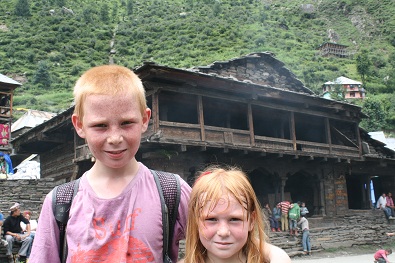 We arrived in the village to a hostile welcome
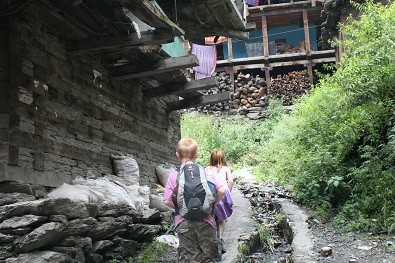 Trying to explore
As we made our way toward the scarcely inhabited village high in the mountains, Malana is world-renowned for its hashish, and the village is now pretty much a working hash factory. Marijuana plants fill the landscape and at up to 9ft tall dominate the surroundings. So important to the villagers is this drug that families who once farmed crops now farm marijuana. Children help make the 'cream', and due to the sheer isolation of the village the authorities are powerless (or unwilling) to help — make your own assumptions. Visitors to Malana are not allowed to touch anything, and people will jump out of your way. The locals are all dressed in simple clothes and look Tibetan in their appearance. Charlie and Abi were mesmerised; this was abnormal to them. I explained it was to me too, but we found a real middle ground with each other when a guy who jumped away from us jumped down a hill and splatted. It was so funny! He was disgusted and started shouting at us in his language (which is unique to the village); we just laughed and walked off.
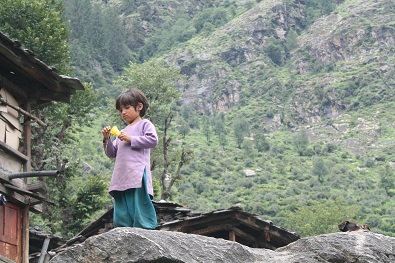 A little girl amusing herself
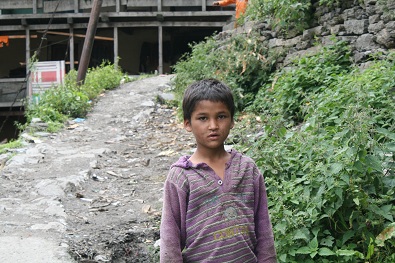 We finally found someone willing to smile
It was difficult to get pictures since everywhere was seemingly out of bounds, but I hope the ones I did get show the village as what it really is, and really it is beautiful. We soon got bored of the people shouting we couldn't go a particular way, people dive-bombing out of our way, and the guys that had been assigned to follow our every move. They did not speak a single word to us, stayed about 5 feet behind us, and followed our every move. What struck me as odd was that although I understand we were seen as being the ultimate scum, and that if we touched anything a whole ritual had to be done to 'cleanse' the area, we weren't allowed to explore their village properly. Why did some kids smile yet others fear us? I think Malana hides a secret much bigger than anyone anticipates. Yes, everyone knows they are at the heart of the drugs trade in the area, but I can't help feeling it's more than that. There was a reason why suddenly all hell would break loose if we tried to go a particular way, or that essentially we were 'guided' subtly most of the time, yet accosted some of the time. It was unnervingly suspicious, and as we descended the killer mountain I thought more about what we had seen and how things were. The locals aren't stupid; they know that by banning people entering the village they will draw untold attention to themselves, but by allowing people in and hampering their efforts to explore they cause, in my mind, even more suspicion and thereby attention. I thought back to the disappearances in the valley and how the village of Malana is mentioned more than a few times in the theories and suspicions: did some people go too far, find things they shouldn't have?
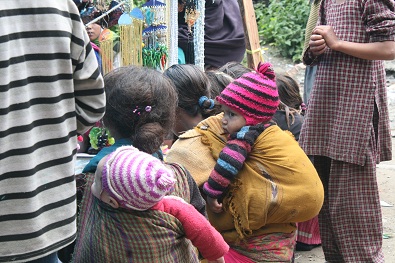 Centuries-old traditions
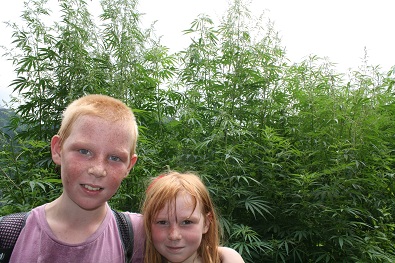 The lifeblood of the village — Marijuana
We soon tired of the harassment from the villagers, and though the view was simply mesmerising my breathing was getting heavier — like I was constantly out of breath and the more I breathed the more lightheaded I got. As we walked back down the mountain I was very thirsty, so much so I was trying to moisten my mouth with the sweat dripping from my lip. Abi was claiming she had a headache, and so I remembered seeing a guy selling water near the entrance to where we trekked. Once there I started to walk up to him and he shouted 'don't touch' and stood up; I tried to appeal to his sympathetic side and pointed to the kids saying water. He threw a bottle of water about a metre away from him and then gestured I throw the money at him. It was bizarre, but it seemed that through the hard front there was a side which was human. As we retreated back down the mountain my lightheadedness had gone, breathing was back to normal, and both kids' headaches had gone.
Faced with mountain sickness we had trekked to an altitude of around 3,200m and visited one of the most isolated, ancient, and unique civilisations on earth. It was the most bizarre experience we have ever had, and I thought back to a little boy I saw looking at us. As I took his photo he flashed a shy smile — a rare sign of humanity. Proof that no one is born prejudiced.