Not far from the church lie the remains of Aberedw Castle. It is situated above the River Edw, which rushes noisily below through a rocky gorge to join the River Wye. Built by the Norman lord Radulphus de Baskerville, who came over to England with William the Conqueror, the castle was later used as a hunting lodge by Prince Llywelyn. Much of the castle site was destroyed when the Cambrian Railway was constructed, and stone from the castle was broken up and used as ballast.
In the year 1282, the English and Welsh were at war, and Prince Llywelyn was on the run. He is said to have spent his last night alive in a cave now named Prince Llywelyn's Cave. Inside, the walls are scratched with the names and dates of visitors who have been in the cave over the years. The legend relates that a local blacksmith reversed the shoes on the hooves of Llewelyn's horse so that the tracks in the snow would mislead his enemies. However, the blacksmith then sold this information to the English troops, leading to Llywelyn's capture and beheading at Cilmeri, near Builth Wells, on a bleak December day in 1282.
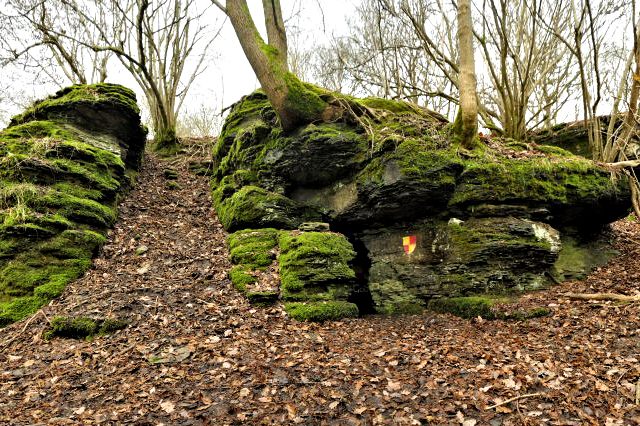
The Aberedw Rocks are crags scattered over the hillside near the village. From the high point there is an excellent view southwards to the Black Mountains and Brecon Beacons, looming dramatically against the sky. The rocks are outcrops of Silurian limestone rising in terraces above the deep gorge cut by the River Wye. On these grassy heights there are grouse, skylarks, meadow pipits, and wheatears to be seen. You may also hear the piped notes of a ring ouzel or catch a glimpse of a merlin. The biggest prize of all is to sight the red kite with its forked tail — the bird which gave its name to the toy because of its hovering skills.