Bretton Country Park, Clayton West and Emley
This walk is set in the area of West Yorkshire close to the Pennines between Huddersfield and Sheffield. The starting point at Bretton Common is easily accessible from the M1 motorway, junction 38. From the start the walk follows a path through a plantation and across a field down to the Yorkshire Sculpture Park, which is set within Bretton Country Park. The outside exhibitions in the sculpture park can be viewed freely, so add a little distance to the walk if you are inclined to wander finding more and more sculptures. From the exhibition areas the walk continues to circle the west side of Upper Lake and then it leaves Bretton Country Park to cross gorgeous countryside all the way to the village of Clayton West. Afterwards the walk climbs over 100 metres along a bridleway and then across more fields on the Pennine fringes to the village of Emley, which is the highest point on the walk. More countryside and the site of old iron workings are then crossed to reach Bank Wood before field and access lanes are followed to a point which crosses the A636 Wakefield Road, which heralds a short climb back to the plantation leading back to Bretton Common.
Statistics and Files
Grid Ref: SE 276 141
Rating: Moderate
Climbing: 345 metres
Time: 5 hours
Ordnance Survey Explorer Maps (1:25,000):
278 Sheffield, Barnsley and Rotherham
288 Bradford, Huddersfield and East Calderdale
The Walk
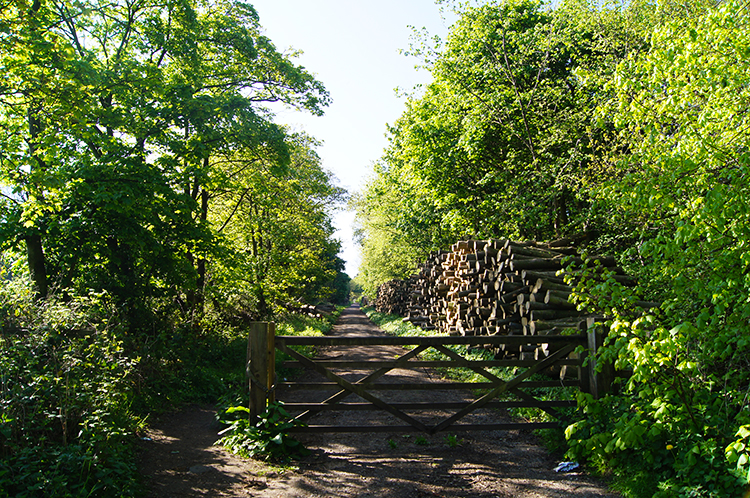 Wilderness Plantation
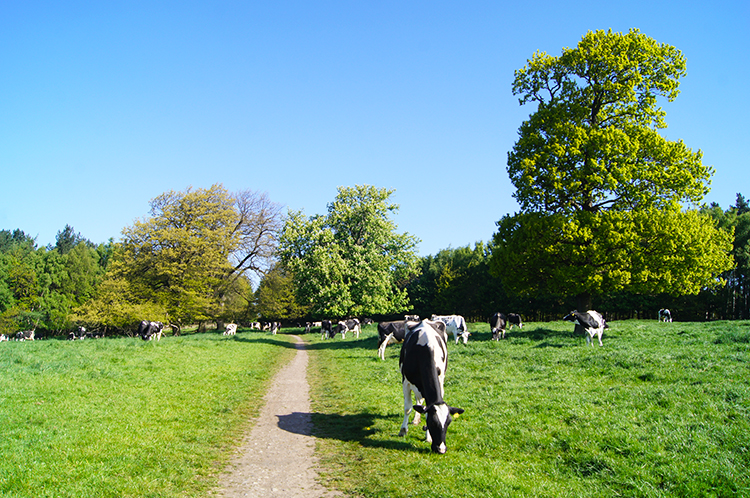 Unassuming Cows
It was a lovely springtime morning which made the thought of doing this walk irresistible. I had planned it for quite some time, and now in the most perfect conditions for walking I was on my way. After carefully crossing the A636 Wakefield Road I strolled down the path through Wilderness Plantation with a wide smile on my face. As I walked I looked up to the trees to spot the birdsong orchestra which was in full performance. It was perfect as usual — a delightful accompaniment to the start of my walk. Sadly the performance ended as I left the enclosure of the plantation to cross a large field leading me down towards the Yorkshire Sculpture Park. As I walked on the good path across the field I passed a herd of the quietest dairy cows which were disinterested in me. As I continued on I enjoyed more brief performances of birdsong by soloists in the scattering of trees, and when walking downhill through the field I turned my head to the right and looked west to the beautiful countryside I would be crossing later on. It was so inviting. First though I had an open invitation to enjoy the exhibits on show in the sculpture park which I could not resist.
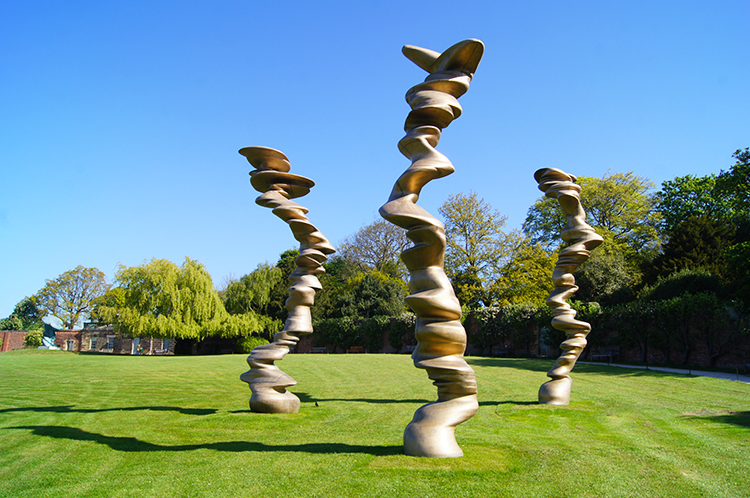 A Tony Cragg work
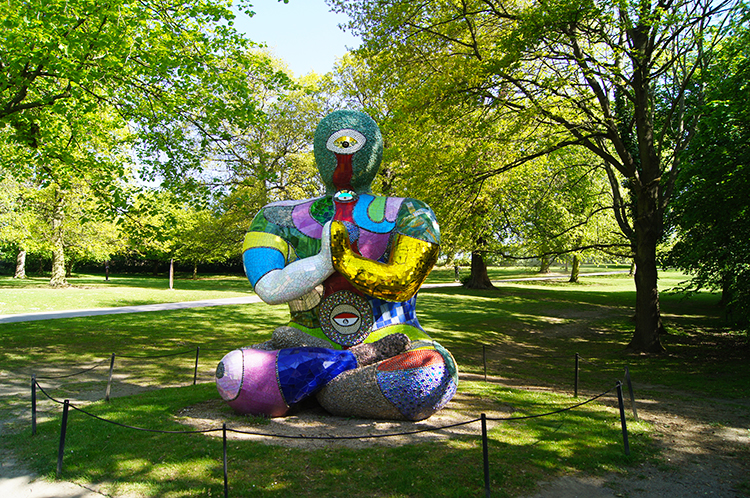 Buddha by Niki de Saint Phalle
I walked from the field and to the entrance to the Sculpture Park. A sign greeted me with: "Welcome to Yorkshire Sculpture Park. Great art and works in 500 acres of historic landscape and five galleries. Enjoy your visit." I intended to, and after just a few steps I was confronted by strange sights. Some of the first were the less strange, moving objects such as the groundsmen mowing the grass and generally tidying up the park for the new day arrivals — I was one of the first. Soon my attention was fixed on the statues and other exhibits in the park which were quite a mix of identifiable art, beguiling figures, thought-provoking shapes, and downright weird goodness-what. The first I came to were simple enough human forms, but the next were offbeat shapes, though one looked like a teapot with a head on top — I think so anyway. Then I came to three contorting pillars which I imagined as petrified tree trunks, and then I came to a multicoloured praying man who turned out to be Buddha. The imagination walk did not end there.
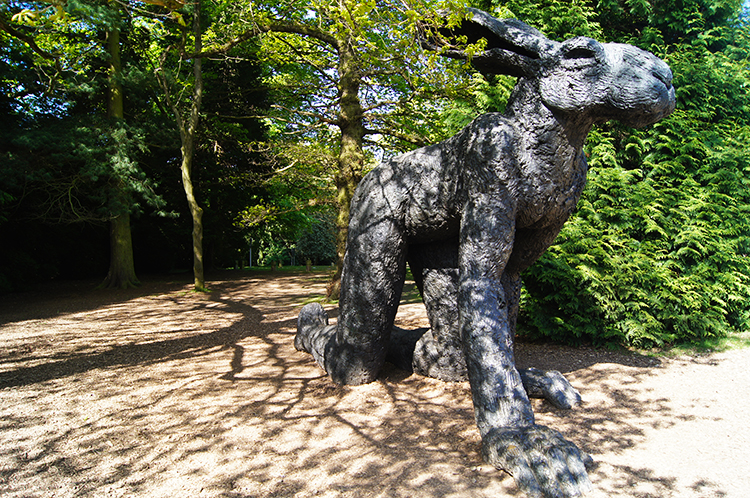 Hare by Sophie Ryder
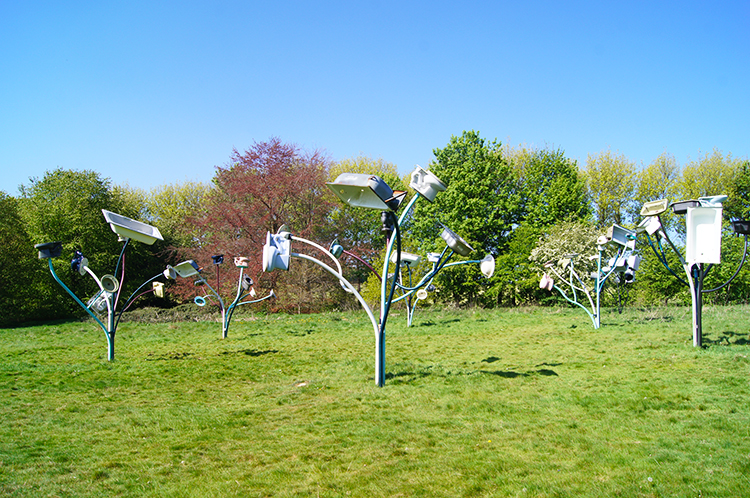 Trees by Dennis Oppenheim
Next I came across a range of weird knobbly and curvy shapes, and then what seemed to be a contorting hare. I would see more of them. More unimaginable shapes followed, and then a series of Troika-type Christmas Island figures arranged in haphazard lines. Next was a lady figure wearing a conical hat and sitting on a bench, then a series of vibrant coloured banners reading "Schools should be all cool," or something like that. Then I came to a more identifiable hare, huge and papier-mâché-like; he was crouching down. Afterwards I came to an even larger sitting rabbit. Both are the work of Sophie Ryder. She has quite an imagination, as does Dennis Oppenheim, whose work I arrived at next. His trees had household wares in place of foliage — wares such as baths, toilets, washbasins, dustbins, buckets, and fence panels. While they were extraordinary I was wandering about his woodland for quite a while working out objects on each particular tree.
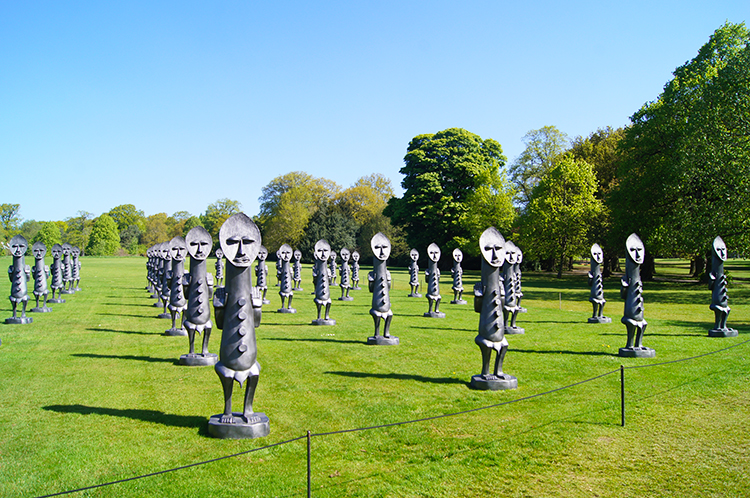 Black and Blue by Zak Ové
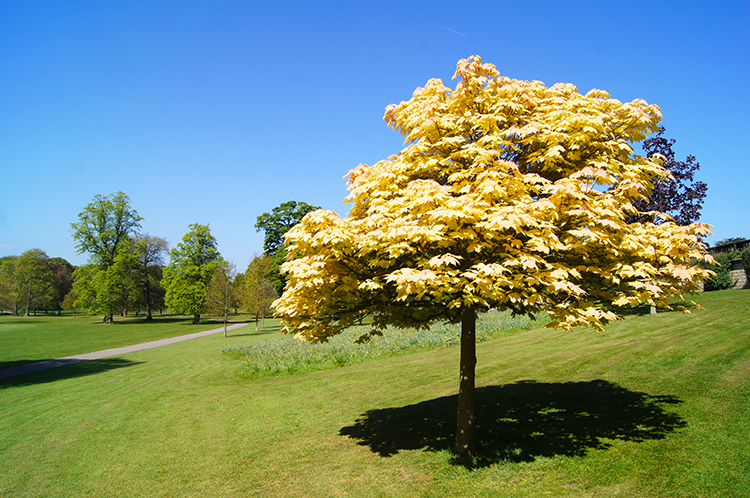 Natural Perfection by the Walking Englishman!
I was aware my walk was taking longer than I had expected and that I should be a couple of miles further on by now, but I could not help it. I had been erratically wandering in the sculpture park for an hour when I arrived at Zak Ové's Black and Blue Army, and during that hour only covered half a mile in distance. I did not feel at all guilty though; it had been a superb thoughtful hour in which I had seen so many wonderful sights. And the Black and Blue Army was a fitting exhibit as a finale: the assembly of figures — which is also known as The Invisible Man and the Masque of Blackness — is an extraordinary army of eighty identical sculptures which have previously stood to attention at Somerset House and Wakefield Art Gallery before their term of garrison at the sculpture park. I was privileged to see them. After claiming a scene as my own personal exhibit I left the field of extraordinary delights behind and continued on to the many thrills yet to be enjoyed on my walk.
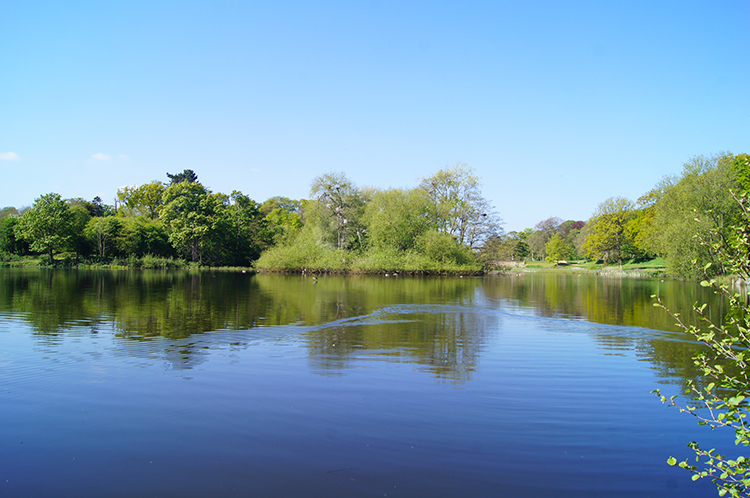 Lower Lake
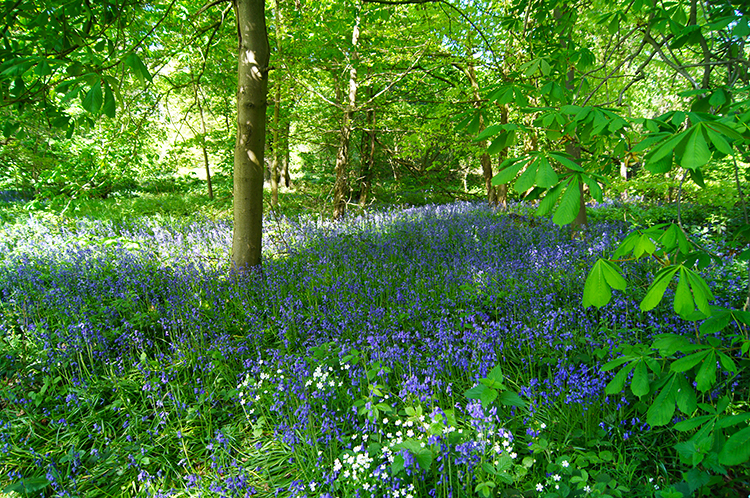 Bluebells in Bridge Royd Wood
The first of the thrills came almost immediately as I walked down to the footpath encircling the two West Bretton Park lakes, which were artificially created by managing the flow of the River Dearne, which I crossed by footbridge to reach the lakes. I arrived at the east side of Lower Lake first and I was immediately fixed to the spot, standing in awe and gawping at the picturesque scene set out before me. The lake was fringed with deciduous trees including native and exotic species — willow, horse chestnut, oak, sycamore, and ash were amongst the ones I identified. All were in full early spring colour, fresh and in various shades of young green. Banks of reeds and bulrushes edged the waterside. I spotted plenty of wildfowl including duck, moorhen/coot, and cormorant. Canada geese were abundant too, and a couple of parents were shepherding their young family near to me on the grass close to the lake edge — I counted eighteen chicks! A chap with his energetic dog approached, and as they got near the geese took to the water. When the geese had all safely launched to water I walked on, heading in an anti-clockwise direction around the lake. Soon I came to my first spectacular display of bluebells in Bridge Royd Wood. It was gorgeous.
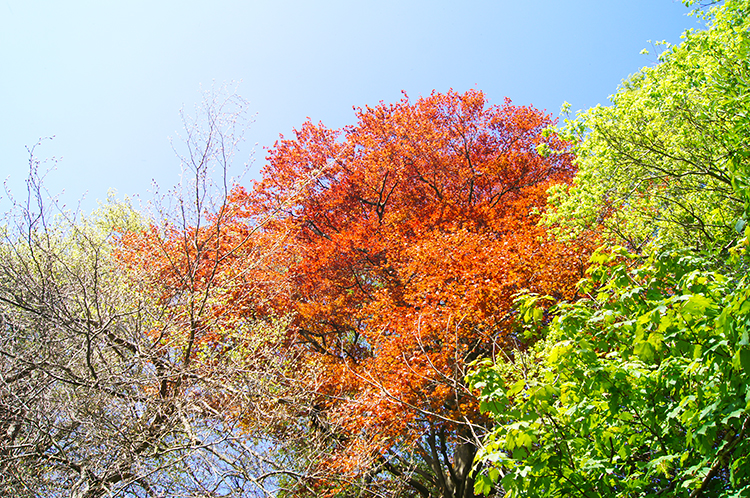 Beauty in Leaf
 Marsh Grass
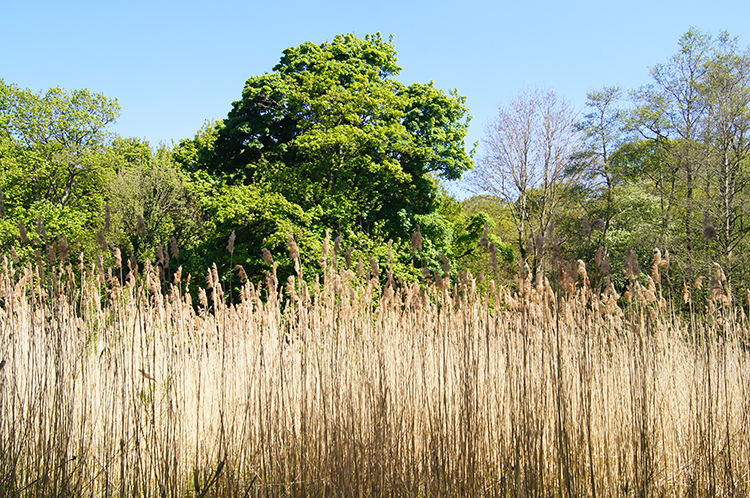
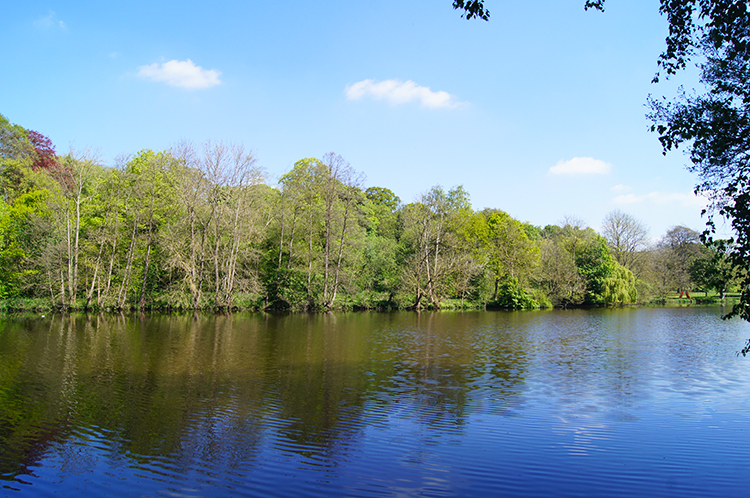
As I continued on my walk around the lake — which took me from Lower Lake to Upper Lake — I was often stopped in my tracks again by sights which took my attention. How on earth was I going to complete this walk with all these interruptions? Not only were the spreads of bluebells in the woodland neighbouring the lake a spectacular sight, but the arrangement of trees in the belt of woodland around the lake were also captivating. Sometimes the pale greens were interrupted by eruptions of glittering copper beech and scorching red acer which caused me to raise my head and look skywards. Then at the western end of Upper Lake I arrived at the managed bog and marsh area; I was smitten by the light grey fields of high marsh grasses. They looked so inviting, and I rushed down to take a few close-up photographs of them. The squidge of mud oozing up over my boots as I reached the grasses made me take it carefully — the beauty of nature has subtle traps sometimes.
 Upper Lake
 Barnsley Boundary Walk
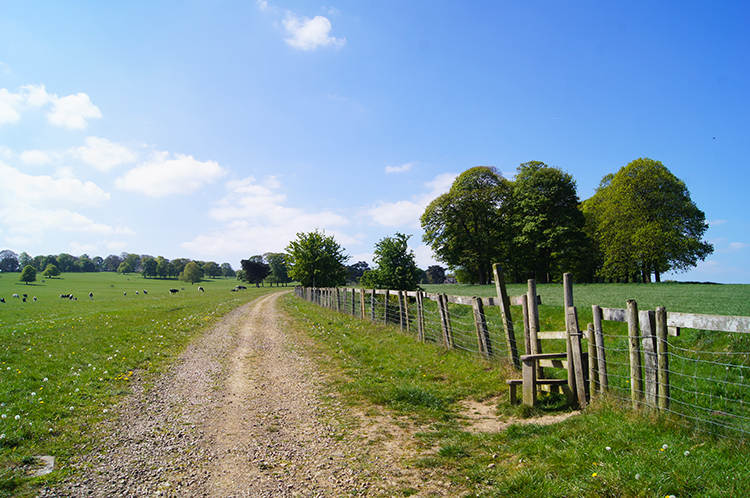
I had managed to keep the water from rising above boot level while taking my swampy shots and soon I resumed my walk on the good path around Upper Lake. My course veered from westbound to eastbound as I continued around the lake to the south side. On this stretch I left the path to take a look through a lakeside bird hide, but all was quiet from the hide's viewpoint so I did not linger. Then I followed a path off the main path which took me to the lakeside again, only this time to 'Shell Grotto', which was designed by architect William Lindley to take advantage of the views on offer. There are shells embedded between the stonework in the grotto, hence the name. After visiting the grotto and walking a further short distance circumnavigating Upper Lake I reached the south side of the bridge which separates Upper Lake and Lower Lake. This heralded my departure from West Bretton Park. It had been an extraordinary visit and so memorable. Now my walk would change as I left the park, which was now filling with people. I took a lonely cross-country course by first following the route of the Barnsley Boundary Walk.
 Near Litherop Road
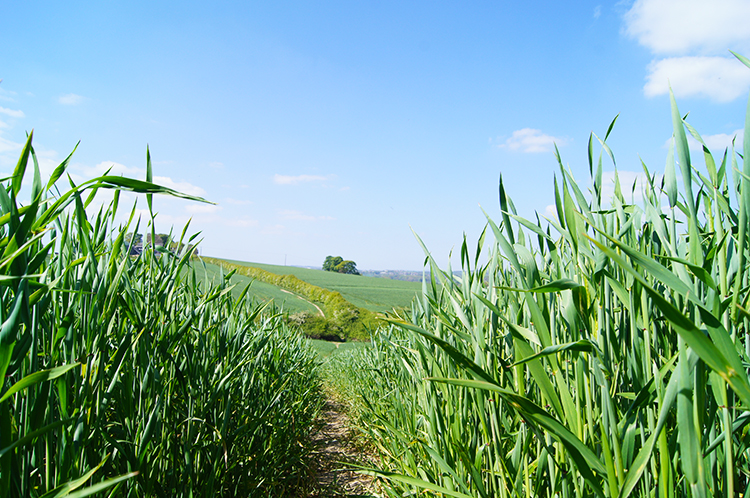 Heading towards Clayton Hall Farm
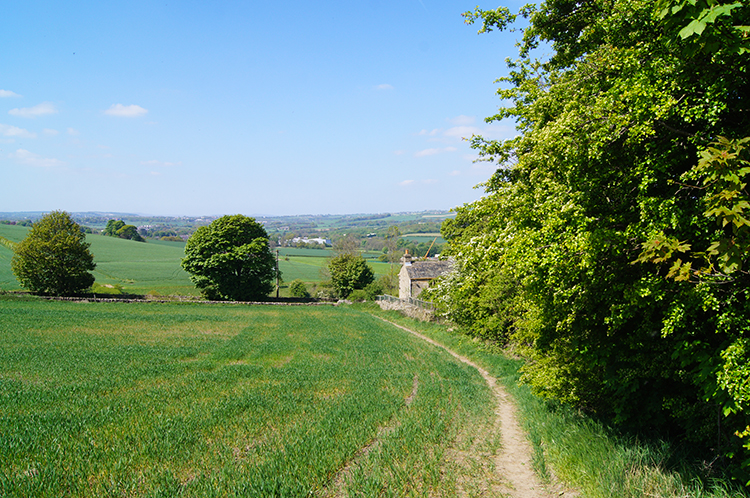
There is no better place to walk than in the British countryside in springtime; that is my view anyway. As I walked along the lanes and across the West Yorkshire countryside between Bretton Park and Clayton West, everything felt right about life. The scene before me was so fresh and green, and at this time I was the only person in the world enjoying it. Even the birds continued to sing out their serenades to their suitors from every tree I passed nearby — or was it warnings of my approach, though surely they could sense I meant them no harm? The paths were good, well maintained, and thus easy to follow, even across the grass and arable crop fields. I had left the route of the Barnsley Boundary Walk some while back and I had crossed the route of the Kirklees Way while following untitled paths. Still they were good ones, and the gates and stiles at field boundaries were in good order too.
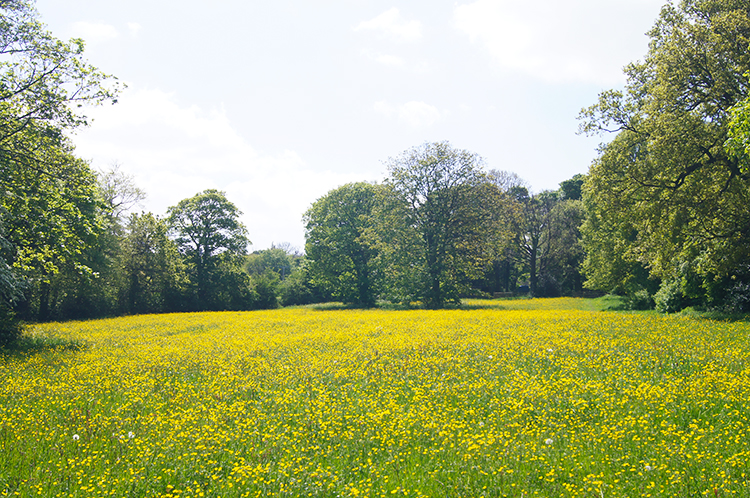 The Park, Clayton West
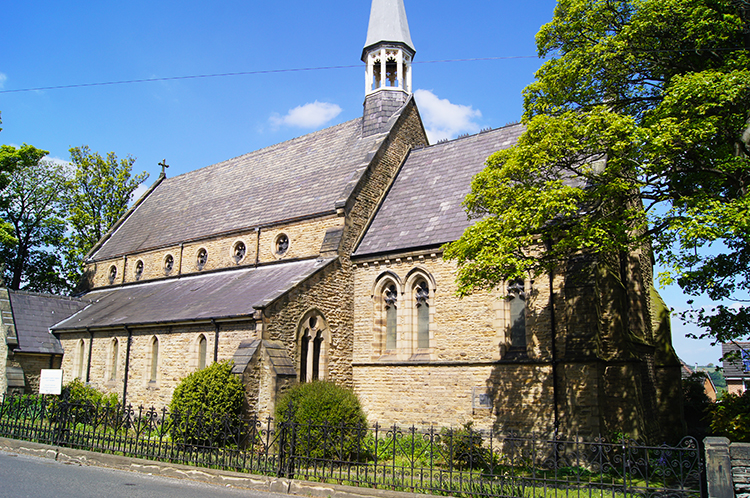 All Saints Church, Clayton West
I arrived in the countryside village of Clayton West via the village park. It was a lovely, well-managed park and clearly well loved by the people of the village. First I crossed an appealing buttercup meadow, all vivid in a mélange of yellow and green. Then I arrived at Kaye's Millennium Green, a park for the people of Clayton West. The sign which told me that invited me to enjoy my visit, which I thoroughly did. On leaving the park I arrived in the village which was very quiet. Despite the gorgeousness of the warm and sunny spring day there were very few people outside. It was nearly noon on a Wednesday though; perhaps most in Clayton West work. I did only see the odd mature couple sat out relaxing or tending their gardens. In the village All Saints Church was particularly lovely.
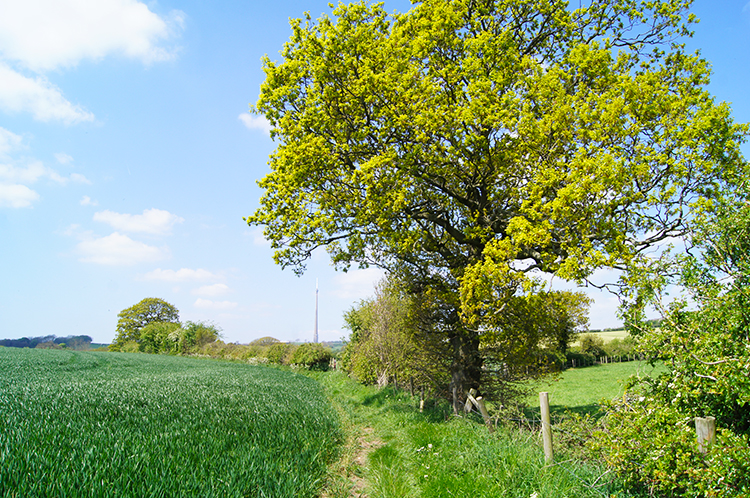 Climbing towards Emley
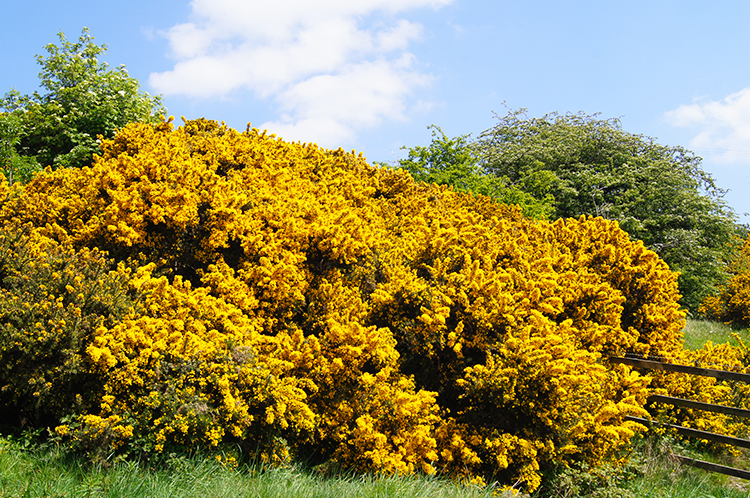 Broom in bloom
I left Clayton West by crossing the A636 Wakefield Road — which I had crossed for the first time at the very start of my walk — and by following the unmade Frank Lane in a north-west direction. Once I jumped into the hedge bank on the lane to avoid being choked and covered in the dust thrown up by a van which hurtled up the lane — the driver was in a hurry. I continued up the lane, missing the turning off which I had plotted. Instead of backtracking I climbed over a gate and crossed a field to regain my intended path. No harm done. I was on the only real climb of my walk now, a 100-metre ascent between Clayton West and Emley. As I climbed along the edge of lush green grassed fields I focused in on the Emley Moor Transmitter. It is an iconic sight-mark of West Yorkshire, and at 330 metres high it can be seen for miles around in any direction. While I would not be visiting the transmitter station it would be a focal point for me until I reached the village which gives the tower its name.
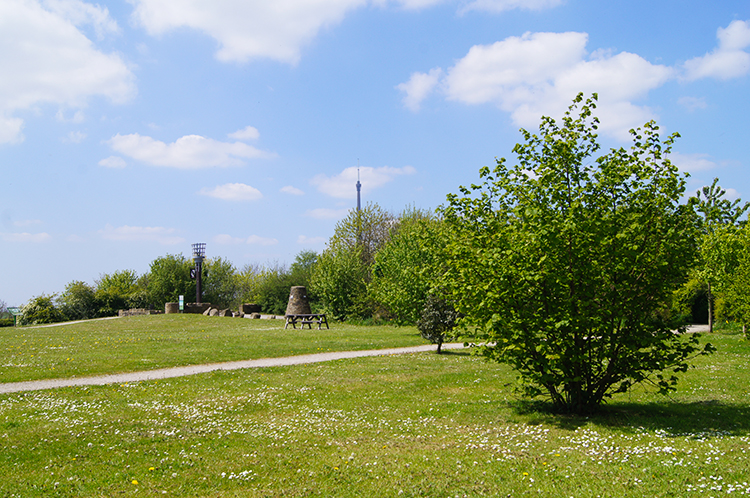 Emley Millennium Green
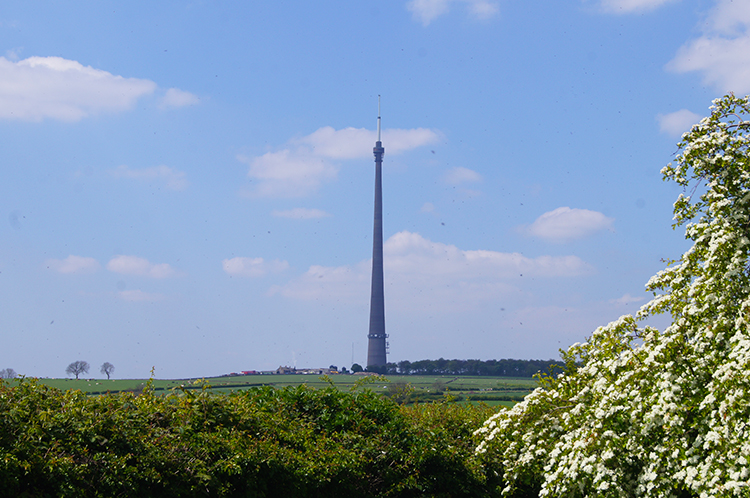 St Michael's Church, Emley
My 100-metre climb provided me with good views back down to Clayton West and the Dearne Valley. Just short of finishing my walk into the village I sat on a stile for a short rest to take a good look. Then I turned my attention back to the walk and arrived in Emley by way of Emley Millennium Green. Just as in Clayton West, the turn of the century had provided a super village amenity. As I had done at Kaye's Millennium Green I wandered around Emley Millennium Green at my leisure. Here I took my lunch break too. It was 1:00 PM and I had been walking for four hours. The sun was still shining strongly though now wispy fair-weather cloud had arrived in the overhead skies. As I crossed the millennium green to Emley Moor I watched the clouds float gently past the transmitter tower.
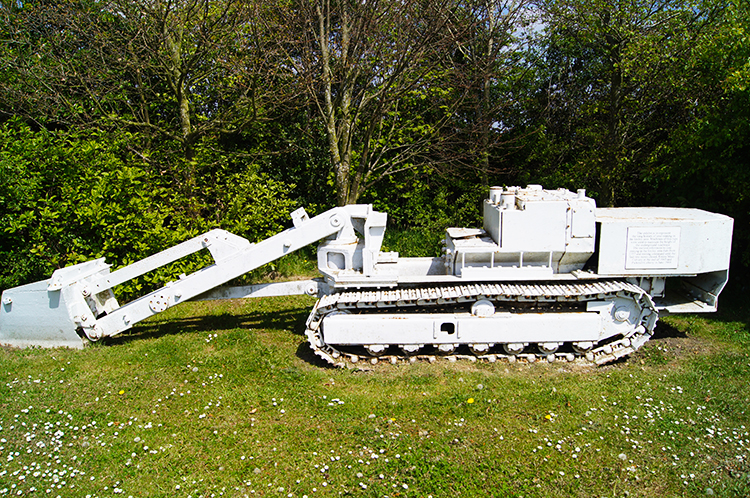 Coal Mining Excavator
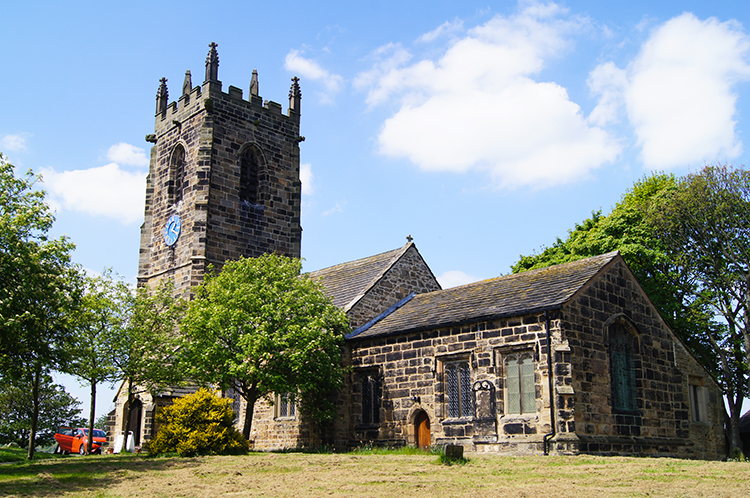 St Michael's Church, Emley
Near to where I was sitting for lunch was a coal mining excavating machine which could have been used at one of the nearby Emley Moor Collieries. Coal mining was extensive in this area of the Pennine Moors up until Emley Moor Colliery closed in 1985 and nearby Parkmill Colliery closed in 1989. The hills are quiet now though. I left the millennium green in such quiet and walked past the village football field to reach the village. As in Clayton West there were not many people about, though I did chat with a couple who were taking a walk to the village convenience shop. As I reached them we chatted and all three of us agreed it was such a lovely day. Turning a corner from one road to another I walked past St Michael's Church before leaving the village and following a farm access lane. A Jack Russell enthusiastically greeted me with yaps and fervent excitement as I reached the farm. He had no bite for me though, just a lot of noise to give — in fact he was a friendly dog. I said hello to him as I passed and continued my walk through the farmyard to access the path I needed which would take me to the site of old iron workings.
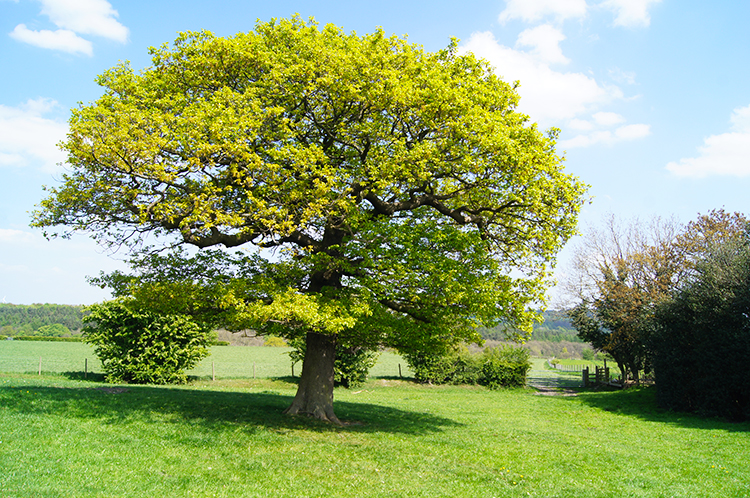 Oak in Spring
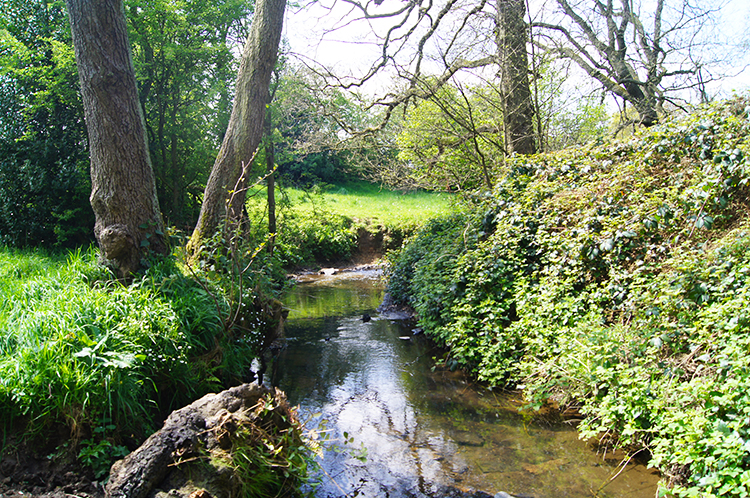 Bank Wood Beck
The iron workings were difficult to make out on this first of two sites I would visit. In fact the area looked more like parkland, as apart from the odd hump and hollow the site looked like a level playing field. There were lovely old oak trees spread at regular intervals in the wide expanse of field, but no real sense of industry — in fact it appeared very pastoral. As I walked on I was rapidly losing the 100 metres height I had gained when walking from Clayton West to Emley. By the time I had cleared the site of iron workings and one more field I had lost it all. I was now standing next to Bank Wood Beck. On a tree stump near to the beck sat a chap taking a late lunch. As with my chat in Emley, we too agreed it was a lovely day to be out enjoying the countryside. I soon left him to enjoy his lunch in peace by walking on, this time south-east along a lane.
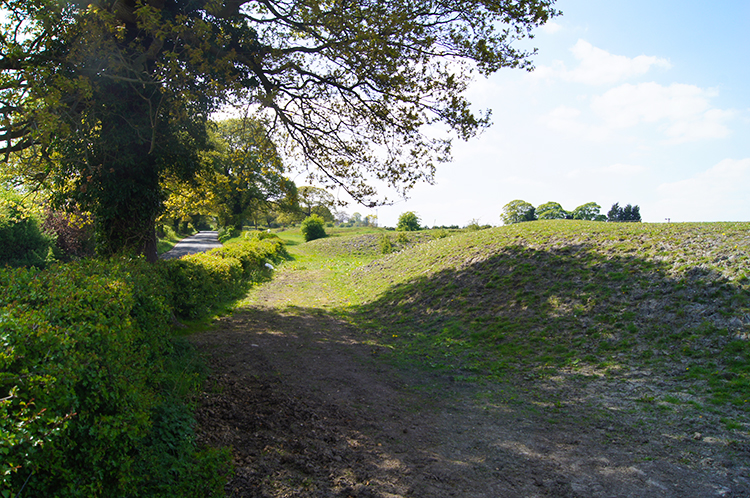 Iron Workings
 Bower Hill Plantation
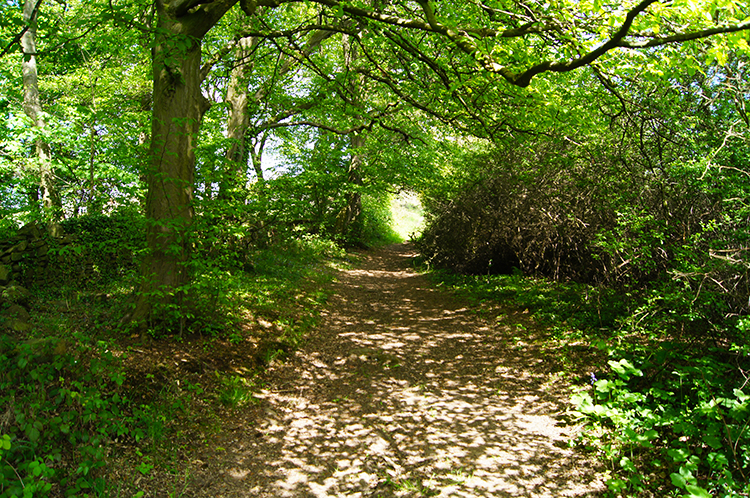
My fabulous walk was coming to an end, but there were a couple more highlights to enjoy before I could take off my boots. The first was at the end of the lane and before I crossed the A636 for a third time. I came to the second site of mine workings, and this time I could clearly make them out as the field of old endeavour was a mass of raised hillocks. They had been created by the spoil derived from iron ore bell pits. It was fascinating to imagine the effort it took to excavate and then derive the ore without the aid of modern machinery — a lot of graft! My second and final highlight was the delightful walk up the leafy lane from Bentley Spring to Wilderness Plantation via the edge of Bower Hill Plantation. It was charming in the dappled shade of the lane and the perfect finale to an eventful walk.
So how can I conclude my walk in a brief summary? What had started out as a thought-provoking exercise in the sculpture park ended with a lovely woodland glade. In between I had enjoyed a fantastic lakeside adventure, crossed exquisite countryside, relaxed in delightful millennium parks, and I had also taken interesting history lessons. Something for everyone, lots for me!